Being: A Self-Curated Residency

When you look at a steep mountain from below, it feels almost unattainable. So vertical and unforgiving that life up there seems unlikely.
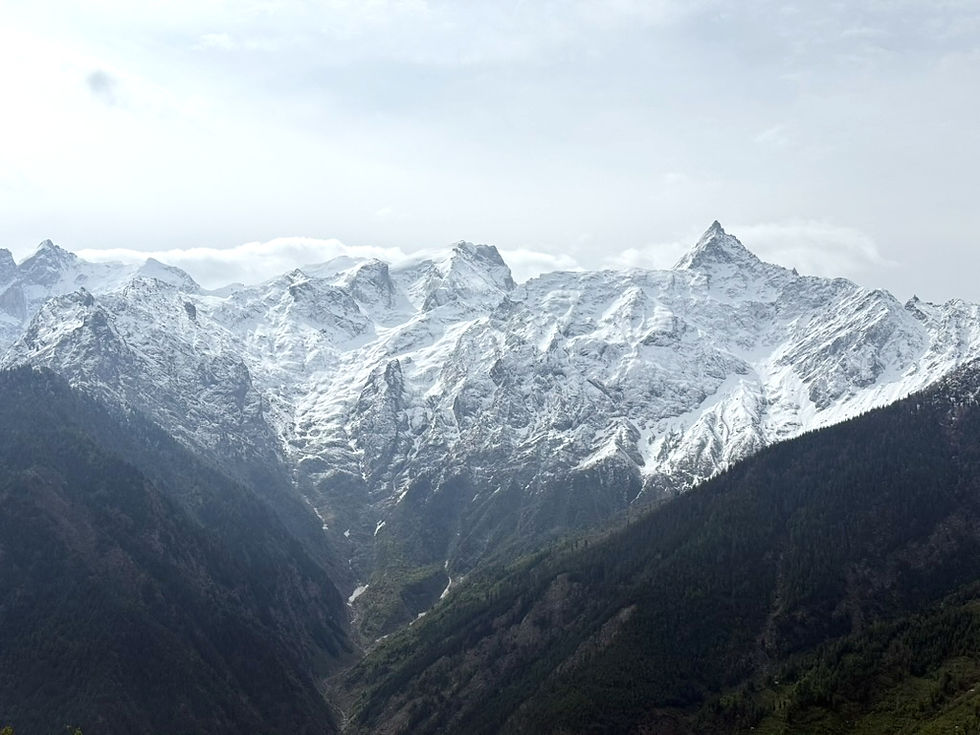
But as you climb, the mountain changes.
What first appeared sharp and inhospitable slowly begins to open up. The landscape plateaus unexpectedly. The air shifts. What looked impossible from a distance starts to feel inhabitable.
And somewhere along the way, without really noticing it, your relationship to the mountain changes too.
You stop looking only at the summit.
You begin noticing smaller things.
Birds knocking against your window in the morning.
The sound of wind moving through the valley at night.
The way silence feels different at altitude.
I think life can feel similar sometimes.
From a distance, certain things seem too large to navigate, too uncertain to move through. But once you begin, you realise most journeys aren’t climbed in a straight line.
There are pauses. Plateaus. Moments where you sit still long enough to realise you’ve already shifted.
I started off this self-curated residency at a point where I was looking to reconnect with my craft and realign with my sense of purpose. But somewhere along the way, it became something else entirely.
Less about searching for answers.
More about observing ways of being.
The trip began at an old friend’s house in Mashobra. We hadn’t spent time together properly in years, life had taken us in different directions, but somehow that hadn’t changed a thing. We laughed, joked, and stayed up having long conversations about life like no time had passed at all.
His house sits on an old apple orchard his maternal grandfather bought almost eighty years ago. The house is full of memories. Of love, companionship, and generations of shared stories that still seem to exist in the walls and gardens around it.
When we first arrived the house was mostly empty, but somehow it didn’t feel empty at all. You could feel the energy of everyone who had passed through it before us.
Varun’s Nani had shaped much of that feeling. Love and companionship seemed to exist at the centre of everything there. She had even started a small farm shop selling produce grown right there on the land, apple juice, jams, preserves.
There was care in everything.
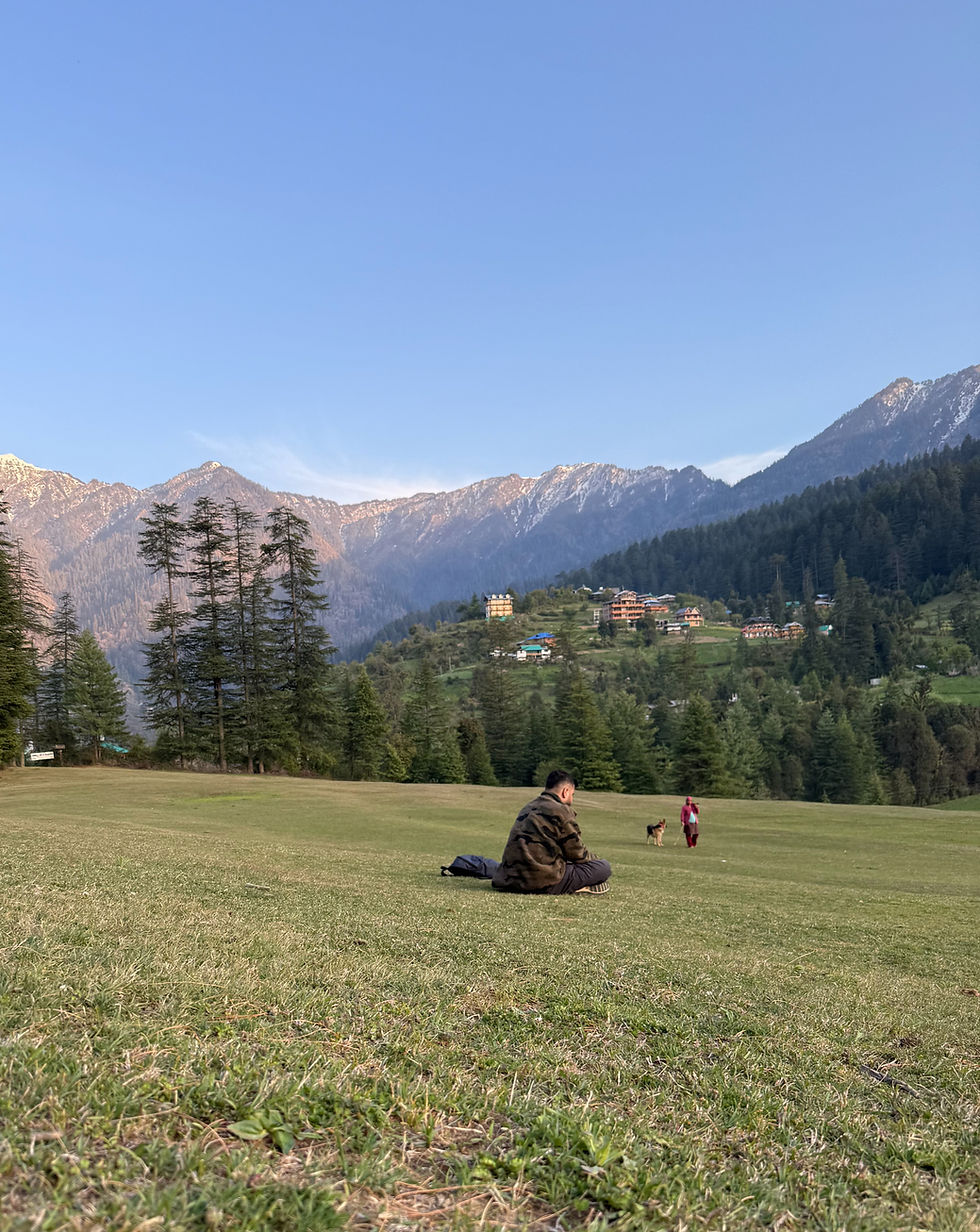
From Mashobra I travelled to Shanghar in the Sainj Valley, where my friend Darpan joined me for the weekend from Delhi. We spent most of our time wandering through meadows, forests, and streams, often sitting quietly for long stretches just breathing in the cold air moving through the valley.
After he left back for Delhi, I was alone for the first time on the journey.
I eventually found myself in a small village near Jibhi called Seri. The village couldn’t have had more than a dozen houses, most belonging to locals, with a few small homestays sitting quietly between apple orchards waiting to bloom.
It was perfect.
I finally had enough space to set up a temporary studio inside the chalet I was staying in. My neighbours, Rob and Georgia, were kind, curious people carrying over thirty instruments with them as they travelled and created. Hira, who owned the homestay, treated us like family, cooking fresh Dal Bhaat with homemade ghee every evening.

There was a rhythm to life there that felt honest.
Mornings began slowly. Evenings stretched naturally into conversation. Nobody seemed particularly concerned with urgency.

After almost two weeks in what had quietly become a home away from home, I left for Rakcham in the Kinnaur Valley, close to Chitkul, the last Indian village on this side.
I reached Rakcham in the middle of the night while it was pouring rain.
I remember calling the owner of the homestay asking him if I should stop somewhere along the way, but he reassured me I’d make it.
So I continued.
The road ahead was barely visible, lit only by the convoy of cars in front of me. On one side was darkness. On the other, a drop disappearing into nothing.
By the time I reached the homestay, the temperature had fallen to -3 degrees.
At dinner there was a group of friends who had ridden their motorcycles up from Delhi for the long weekend. Two couples, another friend, and their child.
Sitting there with them, I kept thinking about how much of life gets negotiated through fear. Fear of discomfort. Fear of uncertainty. Fear that something might go wrong.
And yet some of the most alive moments of this journey only existed because someone decided to move despite it.
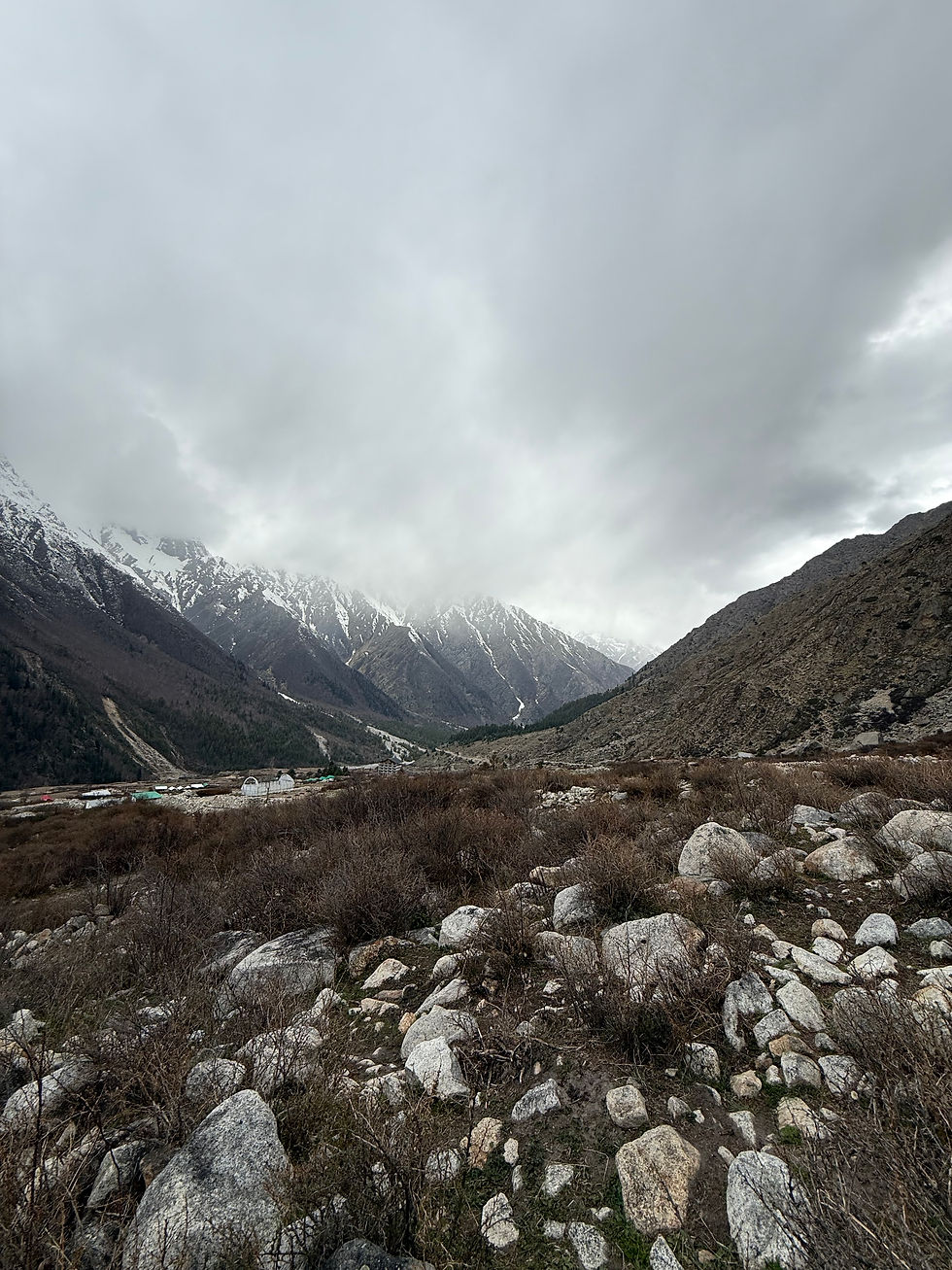
The next day I explored Chitkul properly.
Walking through the village and valley felt surreal. It seemed impossible that people chose to live in terrain this harsh, but at the same time it was unlike anything I had ever seen.
The mountains looked fractured, almost ancient, littered with giant boulders like something
from another world. A freezing blue river cut through the valley, cooling the air around it so sharply it stung your skin.
That evening I made it back to Rakcham in time to watch the United vs Liverpool match with Priyanka and Prashant from Bombay. We sat outside drinking Old Monk, facing a snow-covered peak illuminated by the full moon like a giant candle in the distance.

We shared stories late into the night.
After Rakcham, I continued toward Kalpa.
I arrived around 3pm with no stay booked and, somehow, it was raining again.
While trying to park near a homestay I had found online, my front wheel slipped into an open drain and got stuck.
There wasn’t much I could do except wait.
I sat in the car for a while in the cold rain, stopping tempos as they passed. A few drove by before one finally stopped.
A group of young Himachalis carrying cement in the back told me they would return after dropping their load.
And they did.
Almost forty minutes later they came back and together we managed to push the car free without any damage.
By then the rain had started clearing, so I went looking for hot thukpa before eventually finding the homestay I had originally set out toward, a quiet farm stay away from the crowded town.

There I met Shubham and Jayant from Bangalore, who I ended up travelling toward Nako with the next day.
The drive felt unreal.
The landscape slowly shifted from lush green valleys filled with pine and apple trees into barren rock formations that looked closer to images of Mars than anything I had seen before.
The sun felt harsh even at five degrees. With no trees for shade, there was nowhere to hide from it. And yet the nights dropped well below zero.
From Nako I travelled onward to Tabo, where I paused for a while before eventually heading toward Langza at 14,500 feet.
I spent the night there in a traditional mud home with walls almost two feet thick, built to trap warmth inside. The village still had no running water because the pipes remained frozen.
And yet the stay felt magical.
As night fell, the stars slowly began appearing overhead.
As we waited for the Milky Way to rise above the horizon, we sat around an angheeti at -10 degrees, warming our hands over tea that cooled almost as quickly as it was poured.
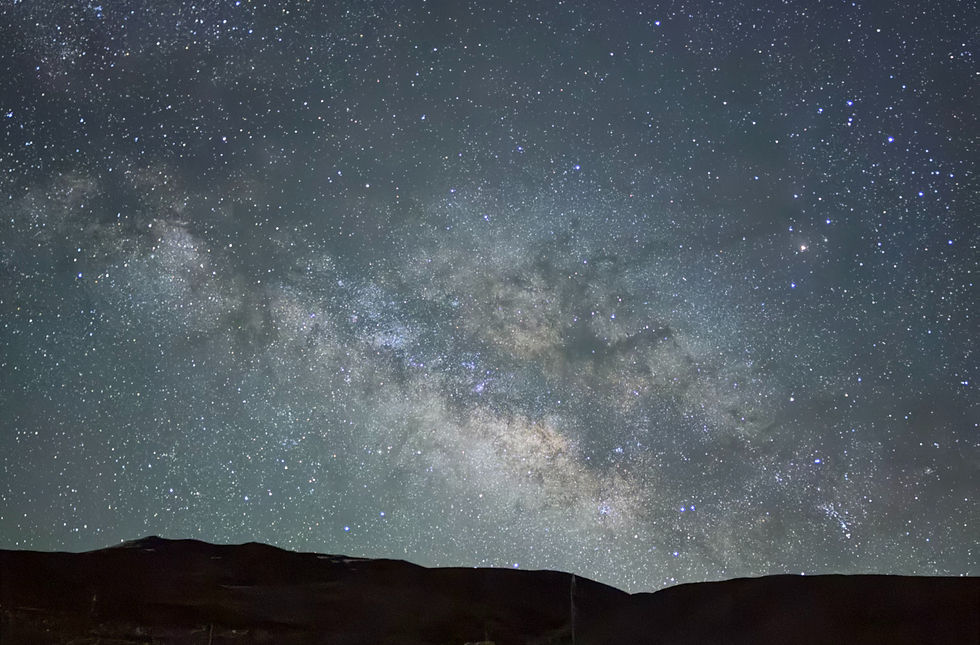
Pankaj, who hosted the stargazing, spoke about the night sky in a way that felt less scientific and more personal.
Born and brought up in Langza, he knew the name of every constellation overhead. Or rather, every version of every constellation.
The Greeks had one name.
Indians another.
Then there were the common names most of us grow up hearing.
Same stars. Different ways of seeing them.
For him, the universe wasn’t just something to look at. It was proof of endless creation, something large enough to hold every perspective we attach to it.
That conversation stayed with me.
Not because it gave me answers, but because of the way meaning seemed to shift depending on who was looking.
Throughout this residency I kept encountering different versions of that same idea.
Rob and Georgia carrying thirty instruments up mountains just to create and exist within the landscape for a while.
Hira and his quiet self-reliance.
Shubham and Jayant travelling away from the constant movement of demanding tech jobs just to sit in silence beneath a sky that didn’t seem to care about urgency.
Each person I met carried their own rhythm.
Their own perspective.
Their own way of understanding what mattered.
Some overlapped.
Others completely contradicted one another.
But somewhere within all those conversations, I kept noticing the same thing:
People are searching for ways to return to themselves.
Sometimes through stillness.
Sometimes through music.
Sometimes through distance, conversation, or silence.
But the intention felt familiar.

People just want to be.
The next day, while driving down from Langza, I saw a clearing beside the road.
It felt strangely familiar, almost like I had been looking for it the entire trip without realising it.
Tyre tracks led into an open patch surrounded by mountains.
So I turned off the road, parked, unpacked my paints, and sat there for the next few hours painting everything I had experienced since leaving Seri.
It was the first time during the journey that I felt fully immersed in creating again.
Eventually the heat began taking its toll. I had run out of water and apple juice could only take me so far.
So I packed up and drove toward Key Monastery.
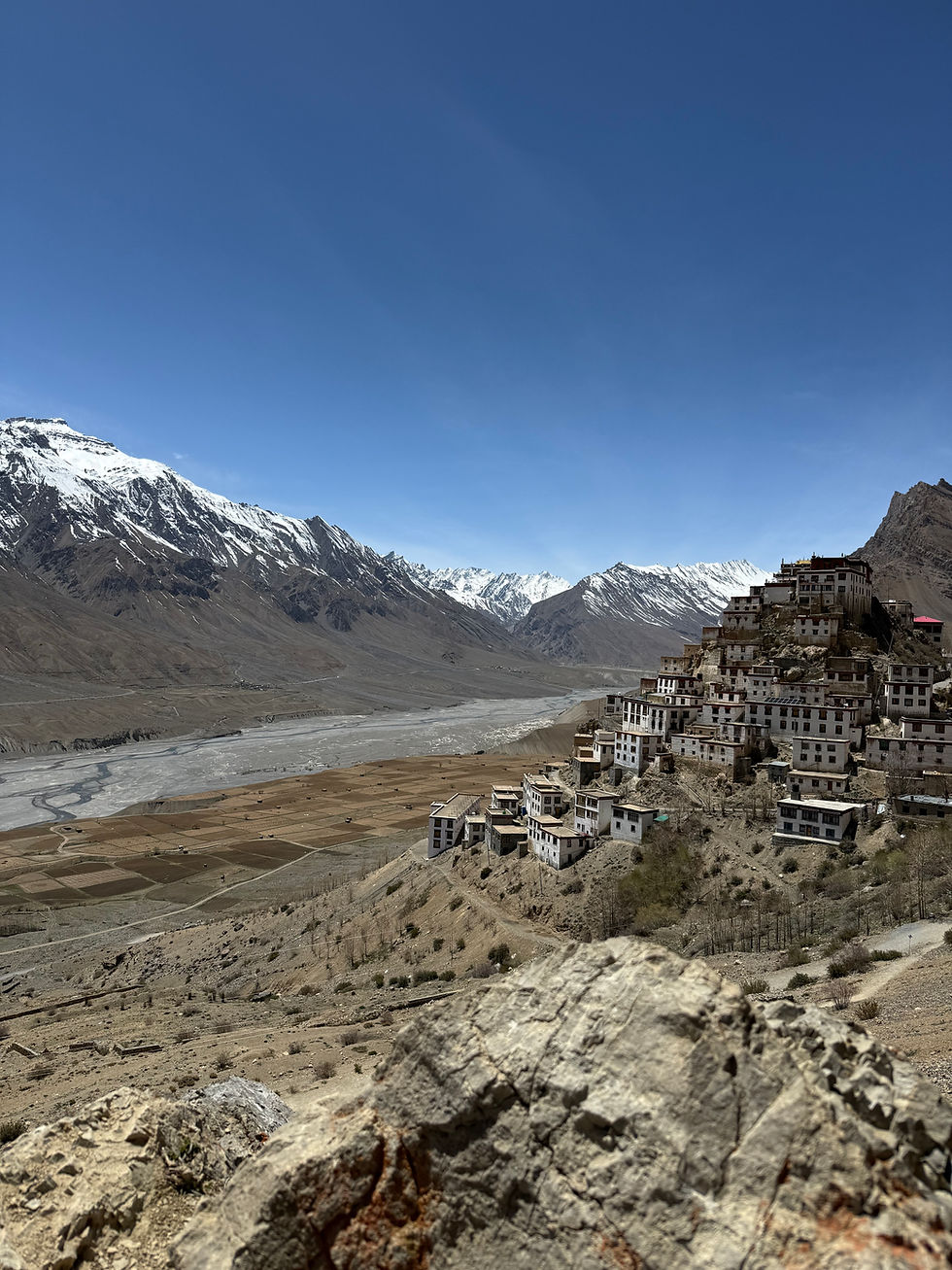
There was a calmness there that’s difficult to explain.
Sitting in caves built directly into the mountains, I found myself letting go of things I had been carrying for years. Forgiving people. Forgiving myself.
Not dramatically.
Just quietly.
After spending hours wandering through the monastery, looking at thousand-year-old thangkas and studying the architecture of the structure from every angle possible, I continued toward Chicham.
A small village at the edge of Spiti, home to the highest suspension bridge in Asia.
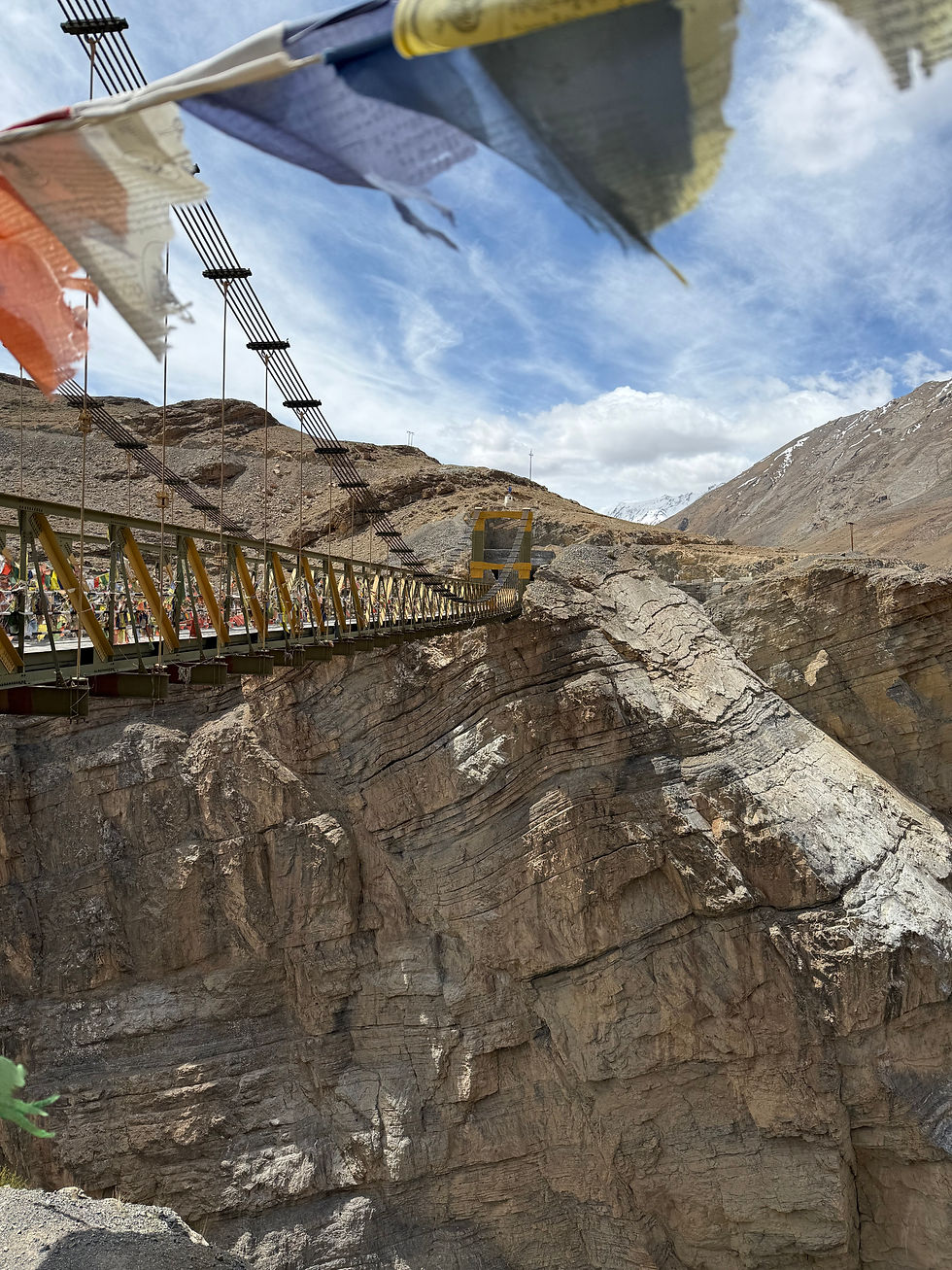
The landscape there felt unreal.
Rock formations slowly opened into vast grasslands surrounded by glaciers and old water veins carved into the mountains over centuries. Even though the grass had not fully grown yet, I could already imagine how alive the valley would become in a few months.
In my excitement, I booked two nights there.
But the next morning I woke up longing for something else.
Pine forests.
Birds.
Conversation.
Warmth.
So I got back into my car and drove.
And drove.
Eventually I reached the turn toward Mudh in Pin Valley, a place several people had recommended I visit.
I stopped the car there for a while.
I knew there would be no phone signal in Mudh, and there were things I needed to sort out. But more than that, I realised I hadn’t truly been able to create properly in days, not since I had left Seri.
In that moment, continuing forward felt more honest than turning away.
So I drove past the turn and continued down the road.
The first call I received once signal returned was from Space Studio Baroda.
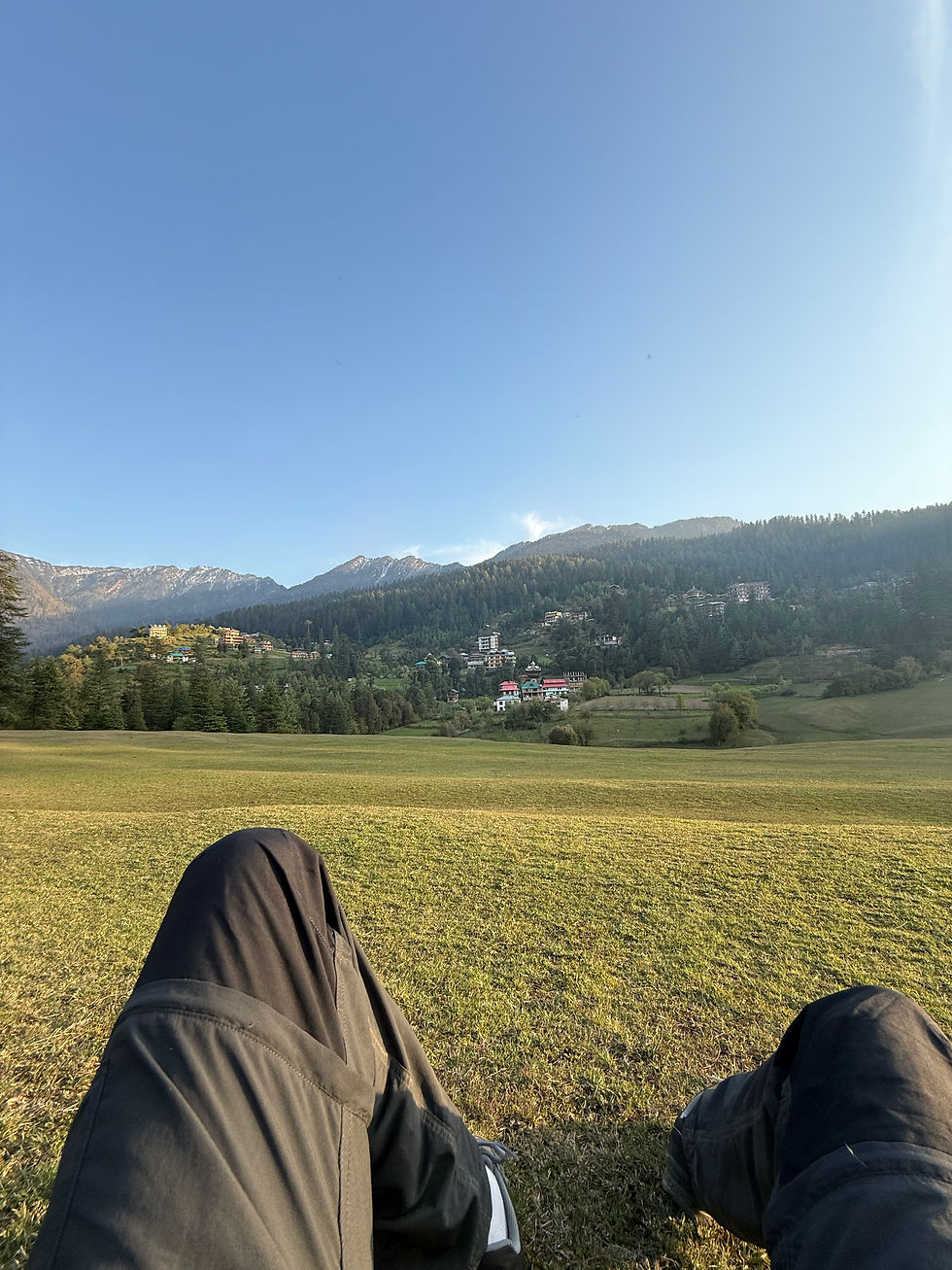
They had been trying to reach me for days to tell me I had been accepted into their monsoon residency programme.
The timing felt surreal.
I had spent years chasing something that often felt impossible to reach, like staring up at a mountain too steep to climb.
And yet somewhere along the way, the mountain had plateaued.
I had finally reached my first meadow.
I suddenly wanted company. Someone to share the moment with.
So I began driving back toward Mashobra, toward where this journey had started.
It took almost two days and over 600 kilometres to make it back.
And when I arrived, the house felt completely different.
Varun’s family had come up for the summer and what once felt quiet and reflective was now overflowing with conversation, food, stories, laughter, and shared memories unfolding in real time.
The house no longer just carried memories in its walls.
It was alive with them again.

And somewhere between the silence of the mountains and the warmth of returning, I began to understand what this residency had really been about.
Not escaping life.
But returning to it more honestly.
Just being.


Comments